Research
Our three research themes — usable and comfortable XR, intelligent adaptive interfaces, and XR for health, training, and safety.
Our research starts with how people perceive motion, space, and their own bodies. We use that understanding in three ways: designing XR that is usable and comfortable across domains, building intelligent interfaces that sense the user and adapt in real time, and taking XR into health, training, and safety settings.
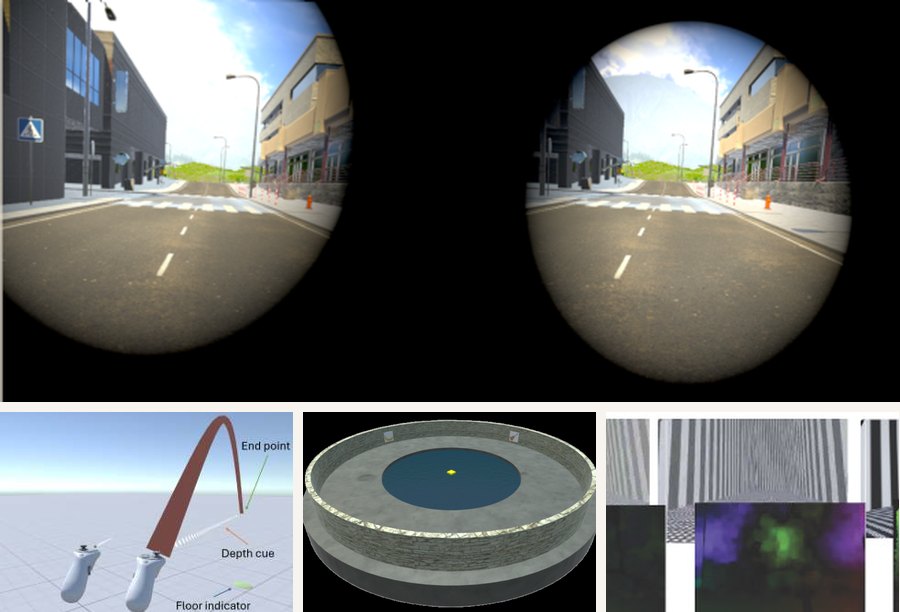
Usable & Comfortable XR
We design around human perception so XR is usable and comfortable across domains and applications.
Questions we ask
- How do visual motion, field of view, and locomotion design shape cybersickness?
- Can people adapt to optic flow, and does that adaptation transfer to new environments?
- How should interaction techniques be evaluated beyond task speed and accuracy?
Selected work
- Peripheral Teleportation: A Rest Frame Design to Mitigate Cybersickness During Virtual LocomotionIEEE TVCG 2025 · Best Paper, IEEE VR
- Revenge of the Sick: A Meta-Analysis of Washout Periods in Cybersickness ResearchIEEE TVCG 2026
- VR Sickness Adaptation With Ramped Optic Flow Transfers From Abstract to Realistic EnvironmentsFrontiers in VR 2022
- Beyond Task Performance: Lessons Learned from Evaluating an Exploratory VR Interaction TechniquearXiv preprint 2026
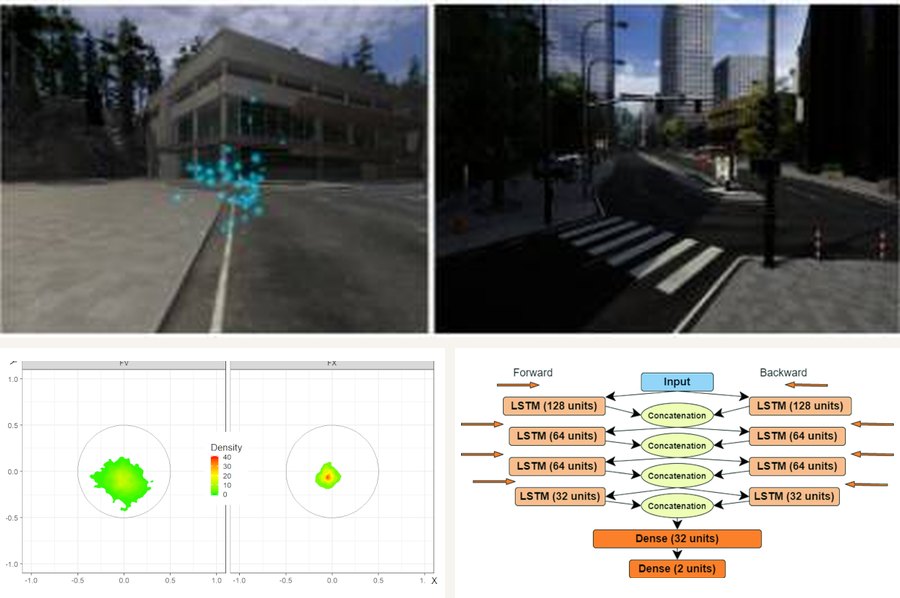
Intelligent Adaptive Interfaces
We sense the user, model their state with machine learning, and adapt the XR experience in real time.
Questions we ask
- Which eye and head movements reveal discomfort, attention, or injury, and how early?
- Can computational models of visual motion predict cybersickness before it happens?
- How can an XR system adapt to each user in real time instead of using one fixed setting for everyone?
Selected work
- How Early Can You Tell? Early Eye Gaze Dynamics and Cybersickness Progression in Virtual RealityarXiv preprint 2026
- Objective Estimation of Cybersickness Using Spatially Resolved Visual Motion MetricsIEEE VR Workshops 2026
- Analysis of Smooth Pursuit Assessment in Virtual Reality and Concussion Detection Using BiLSTMISVC 2022
- GazeMetrics: An Open-Source Tool for Measuring the Data Quality of HMD-Based Eye TrackersACM ETRA 2020
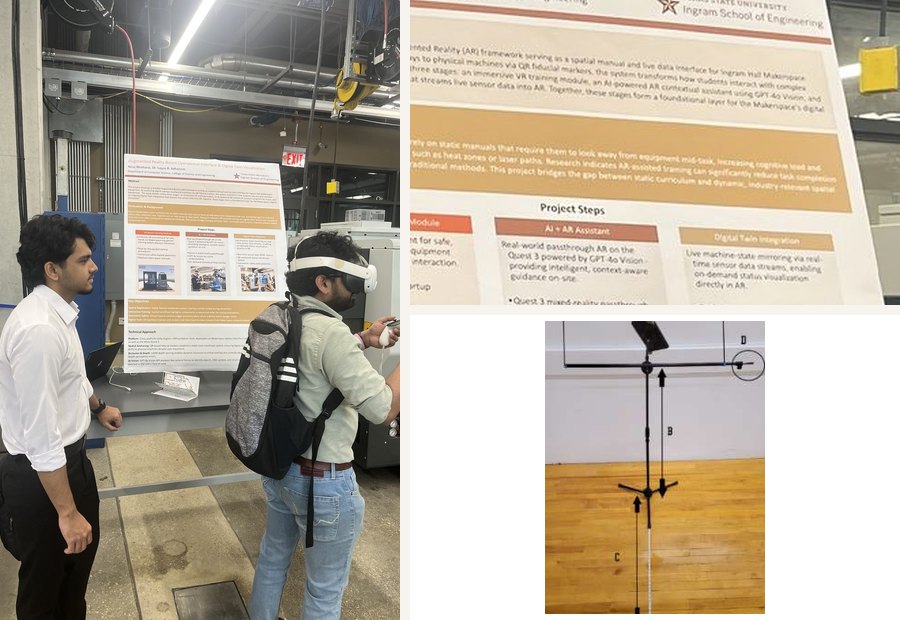
XR for Health, Training & Safety
We take XR out of the lab, from phone-based AR on shop-floor equipment to VR concussion screening.
Questions we ask
- Can a phone and a printed marker replace specialized headsets for on-the-job AR training?
- How should safety zones and step-by-step instructions be shown on real equipment?
- Can VR make clinical screening, such as concussion assessment, more standardized and accessible?
Selected work
- Augmented Reality Operational Interface and Digital Twin VisualizationOngoing project · Ingram Hall Makerspace grant, 2026
- VOMS Baseline Versus Postinjury — a VR Application in Sport-Related ConcussionSports Health 2026
- Virtual Reality Application for Vestibular/Ocular Motor Screening: Current Clinical Protocol Versus a Novel PrototypeSports Health 2024
Support
Our research is supported by:
- Texas State University Research Enhancement Program
- Texas State University Unity3D Faculty Innovation Grant
- Ingram Hall Makerspace grant